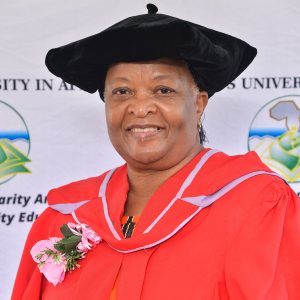
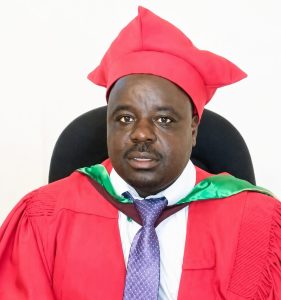
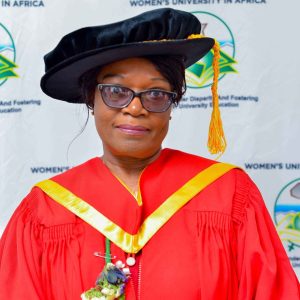
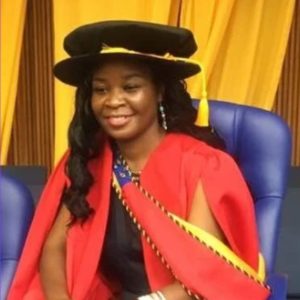
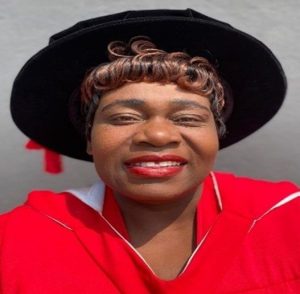
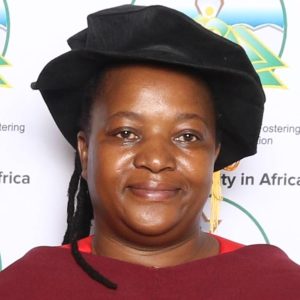
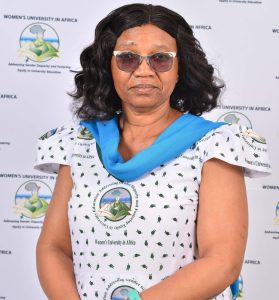
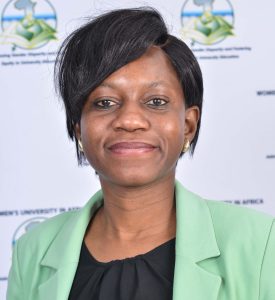
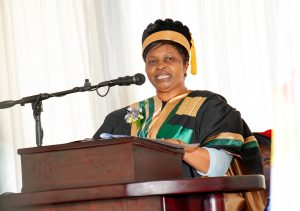
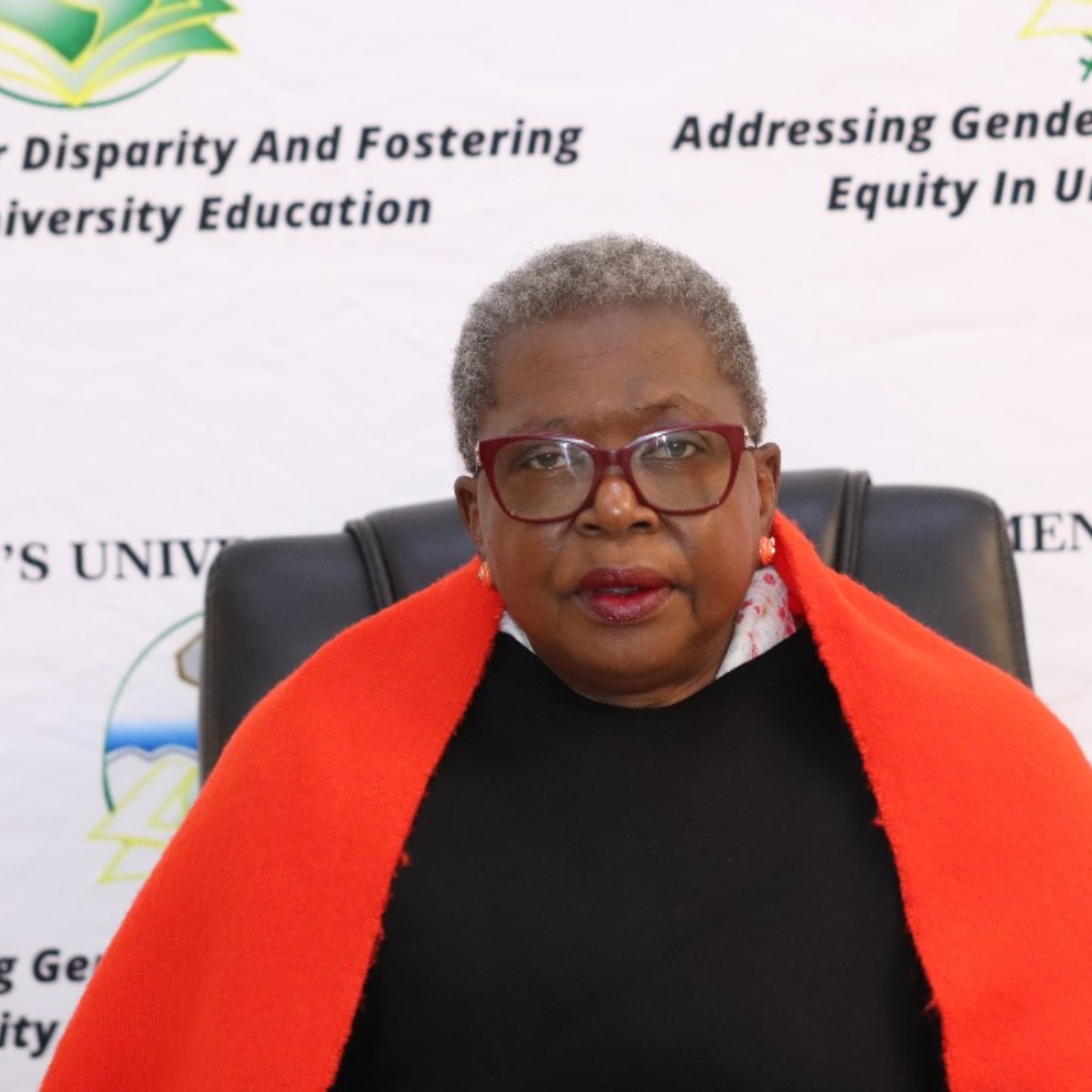
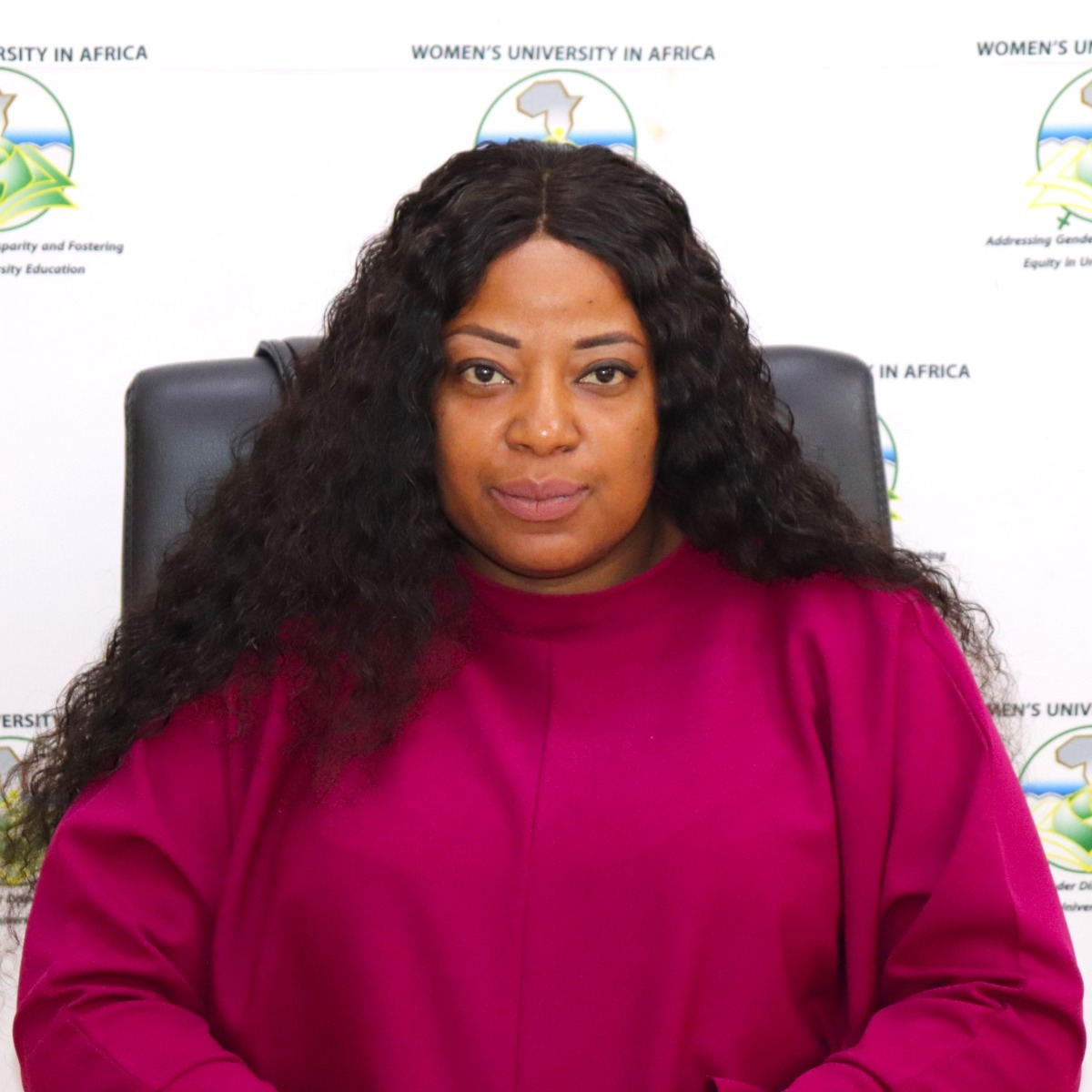
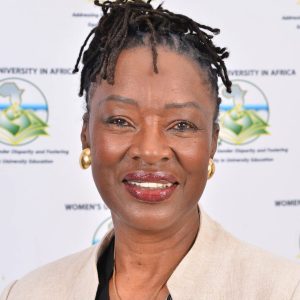
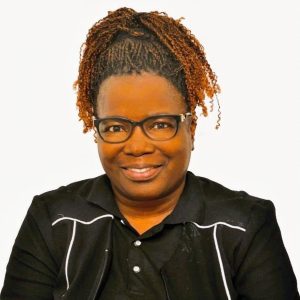
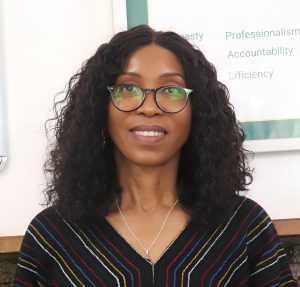
Dr Hellen Venganai is the inaugural Director of the Gender and Diversity Centre. She is a gender expert and researcher with over 10 years of progressive experience working in gender and women’s rights context. She also possesses leadership experience working in academia, civil society, private sector, and media with high level interaction with various stakeholders.
She holds a PhD in Sociology from Stellenbosch University, a Masters degree in Development Studies from Institute of Social Studies – Erasmus University Rotterdam where she specialised in Women, gender and Development. She also holds an undergraduate degree in Sociology and Gender Development Studies from the Women’s University in Africa, and a National Diploma in Journalism from Harare Polytechnic. She has taught courses in Development Studies, Child Sensitive Social Policies, and Gender Studies. She also possesses experience in supervising PhD theses and MSc and BSc dissertations. Dr Venganai has expertise in women rights centred research and her research interests revolve on gender, child rights, women’s rights, sexuality, culture, postcolonial studies, and development policies. Some of her previous publications focused on sexuality, identity construction, and gender based violence, sexuality and culture. Her doctoral research was on understanding the significance of cultural practices, notably labia elongation, in the lives of young urban Shona women and men in contemporary Zimbabwe. She has also been involved in a regional research project by the Stellenbosch University Department of Economics on the contemporary roles of African women in politics in Sub-Saharan African countries. At a personal level, Dr Venganai is also a gender and child rights advocate.
Education and Qualifications
2017 PhD in Sociology, Stellenbosch University, South Africa.
2012 MA in Development Studies (Women, Gender, and Development), Erasmus University Rotterdam (Institute of Social Studies), Netherlands.
2009 Certificate in Monitoring & Evaluation
2009 BSc Honours in Sociology & Gender Development Studies, Women’s University in Africa, Zimbabwe.
2001 National Diploma in Mass Communication, Harare Polytechnic, Zimbabwe.
Record of Employment
2022 – Present Director, Gender and Diversity Centre
2018 – 2022 Senior Lecturer in Development Studies, Child Sensitive Social Policies, Gender Studies, Women’s University in Africa.
2009 – 2010 A& R Executive, Gramma Records.
2007 – 2010 Corporate Communications Officer, Gramma Records
2005 – 2007 Executive Producer (Continuity), Radio Zimbabwe, Zimbabwe Broadcasting Corporation.
2002 – 2007 Producer/Presenter, Radio Zimbabwe, Zimbabwe Broadcasting Corporation.
University Service
2021 – 2022 Chairperson, Gender Transformative Sciences Department
2021 – Present Member, University Research Board
2019 – Present Member, Higher Degrees Committee
2019 – 2020 Child Sensitive Social Policies Programme Coordinator
Recent Research (WUA Funded)
Interrogating Christians’ participation and spirituality in virtual church services: A gendered perspective.
Navigating Street Vending During the Covid-19 Pandemic: The Lived Experiences of Women Street Vendors with Disabilities.
Selected Academic and Media Publications
Woyo, E., & Venganai, H. (2022). Situating Gender and Disability in Tourism Scholarship in Africa: An Introduction to Intersectional Perspectives. In Gender, Disability, and Tourism in Africa: Intersectional Perspectives (pp. 1-29). Cham: Springer International Publishing.
Venganai, H. & Benhura, A. (2022) Interrogating gendered exclusion of womxn in COVID-19 vaccination policies and practices in Southern Africa, Agenda, DOI: 10.1080/10130950.2022.2111082
Benhura, A. & Venganai, H. (2022). Exploring Gendered Monitoring and Evaluation of the Social Protection System in Angola: A Rights‑Based Perspective. Journal of Human Rights and Social Work. https://doi.org/10.1007/s41134-022-00218-z
Venganai, H., 2021. Extending Conversations around Labia Elongation beyond Heterosexual Encounters. African Arguments. https://africanarguments.org/2021/04/extending-conversations-around-labia-elongation-beyond-heterosexual-encounters/
Venganai, H., 2020. Covid-19 prevention measures should leave no school child behind (NewsDay, 28 May 2020). https://www.newsday.co.zw/2020/05/covid-19-prevention-measures-should-leave-no-school-child-behind/
Venganai, H., & Benhura, A., 2020. Girls’ stolen voices, future (Sunday Mail, October 2020).https://www.sundaymail.co.zw/girls-stolen-voices-future/amp?fbclid=IwAR30wWQrTmQrD8lskIj5840lt0xA17kh2W7rEIxhOo17J99CVX1LU_v3wWo
Venganai, H., 2019. “These things might be there in the Bible, but they are hidden” – Christian appropriations of the practice of labia elongation in Zimbabwe. The African Journal of Gender and Religion, 25(1), pp. 1-26. https://doi.org/10.14426/ajgr.v25i1.5
Mbereko, A., Scott, D., & Venganai, H. 2019. Experiences of different household structures caring for people living with HIV and AIDS in the antiretroviral era: Case study of Nyamakate rural area in Zimbabwe. Cogent Social Sciences 5, pp. 1-16. https://doi.org/10.1080/23311886.2019.1565075
Venganai, H., 2018. Reinterpretation of “Traditional” bodily modifications by young people in contemporary Zimbabwe. Africa Development, 43(1), pp. 43-60. https://www.ajol.info/index.php/ad/article/view/190301
Venganai, H., 2017. Urban Shona women negotiating their identities through the cultural practice of labia elongation in contemporary Zimbabwe. Culture Unbound: Journal of Current Cultural Research, 8(3), pp. 306-324. https://www.genderopen.de/handle/25595/1437
Venganai, H., 2015. (Re) constructing positive cultures to protect girls and women against sexual violence. Agenda, 29(3), pp.145-154. https://doi.org/10.1080/10130950.2015.1052679
Venganai, H., 2015. The Gendering and Sexualisation of Young Women through Sex Educational Practices and Discourses in Southern Africa, in J. Wyn and H. Cahill (eds.). Handbook of Children and Youth Studies, pp.289-300. Springer: Singapore.
Consultancies
Dr Venganai has experience in consultancies including being part of the WUA team that developed the UNICEF funded Conflict and Gender responsive Social Protection Delivery Handbook and Training Manual for the Ministry of Public Service Labour and Social Welfare. She has done consultancy work for community based organisations (CSOs) on vulnerabilities of adolescent girls and young women including child marriages in various districts. Dr Venganai was also part of the team of WUA consultants who conducted the Supporting Adolescent Girls Education (SAGE) Beneficiary Identification Programme for Plan International Zimbabwe.
Conferences/Workshops/Seminars attended;
Presented in the Round Table on Gender, sexuality and social justice: unpacking dominant development and policy discourses at the 16th European Association of Development Research and Training Institutes (EADI) General Conference (online): Solidarity, Peace and Social Justice, 5-8 July 2021.
Presented a paper titled “Rethinking queerness in the context of labia elongation”. 8th European Conference on African Studies, Edinburgh University, Scotland, 11-14 June, 2019.
Presented paper titled “Equal rights are okay, but we may end up having makanda asina nzungu (empty shells without groundnuts): The social construction of women interested in politics by young people in Masvingo urban”. Gender equality and the human rights of women in Zimbabwe National Symposium, Harare, Zimbabwe, 5-6 November, 2018.
Presented a paper titled “Bodies at the centre and voices on the margins: Debating women’s contraceptives in Zimbabwe”. 14th Development Dialogue on “Do We Need to Grow” Problematising Growth Economy in Development. International Institute of Social Studies, Erasmus University Rotterdam, Netherlands from 21st to the 22nd of November 2016.
Presented a paper “Why do you go to the gym if you were created perfect?” – Unpacking the ‘modern’ African body through ‘traditional’ bodily modifications. CODESRIA International Conference on (Re) Making African Bodies. Dar es Salaam, Tanzania, 3-4 November, 2016.
Presented a paper titled “The place of the “traditional” sexual practice of labia elongation in the lives of young urban Shona women and men in contemporary Zimbabwe.” 9th Global Persons and Sexualities Conference. Mansfield College, Oxford, United Kingdom, 10-12 July, 2016.
Presented a paper titled ‘Even whites do it’: A Study of labia elongation with young women and men in Zimbabwe. New Social Forms Seminar Series, Department of Sociology & Social Anthropology, Stellenbosch University, 26 May 2016.
Presented a paper titled “Thinking about researching culture in ways that do not reproduce gendered stereotypes”. 22nd Annual South African Sociological Association Conference. University of Johannesburg, South Africa. 28 June – 1 July, 2015.
Attended the Social Sciences for Development Conference. Stellenbosch University. Stellenbosch. South Africa. 9 – 10 September, 2015.
Attended the Narrating Lives and Living Stories in Contexts of Socio-political Change Symposium. Wits University, Humanities Graduate Centre. Johannesburg. South Africa. 7 – 10 July, 2015.
Attended the Colloquium on Young people engaging in/for non-violence and equality: Challenges, opportunities and constraints – Finland/South Africa Research Cooperation. STIAS. Stellenbosch. 29 – 30 September, 2014.
Honours/Awards
- Awarded a research grant by the Raoul Wallenberg Institute of Human Rights and Humanitarian Law (Sweden) for a study on the gendered analysis of Cyclone Idai disaster interventions in Chimanimani, 2020.
- Awarded a research grant by the Raoul Wallenberg Institute of Human Rights and Humanitarian Law on Gender Equality and the Human Rights of Women in Zimbabwe, 2018.
- Awarded the Stellenbosch Institute for Advanced Study (STIAS) scholarship to pursue PhD studies, 2014;
- Awarded an Overall Distinction MA Degree 2012;
- Awarded Distinction for my research paper titled ‘We See It Differently: Examining Power/Knowledge in the Contestation of the WHO’s Interpretation of Male Circumcision’, 2012;
- Awarded a Nuffic Scholarship to pursue MA studies, 2011;
- Awarded Trophy for Overall Best Student in the Social Sciences, Women’s University in Africa, 2009;
- Awarded Book Price for Best Student in Sociology Degree, Women’s University in Africa, 2009.
Tel (Bus): +263 242 459601 |459647
Mobile: +263 774 399 281 | +263 715 378 638
Skype: hellen.venganai
Email: hvenganai@wua.ac.zw
Twitter handle: @hellen_venganai