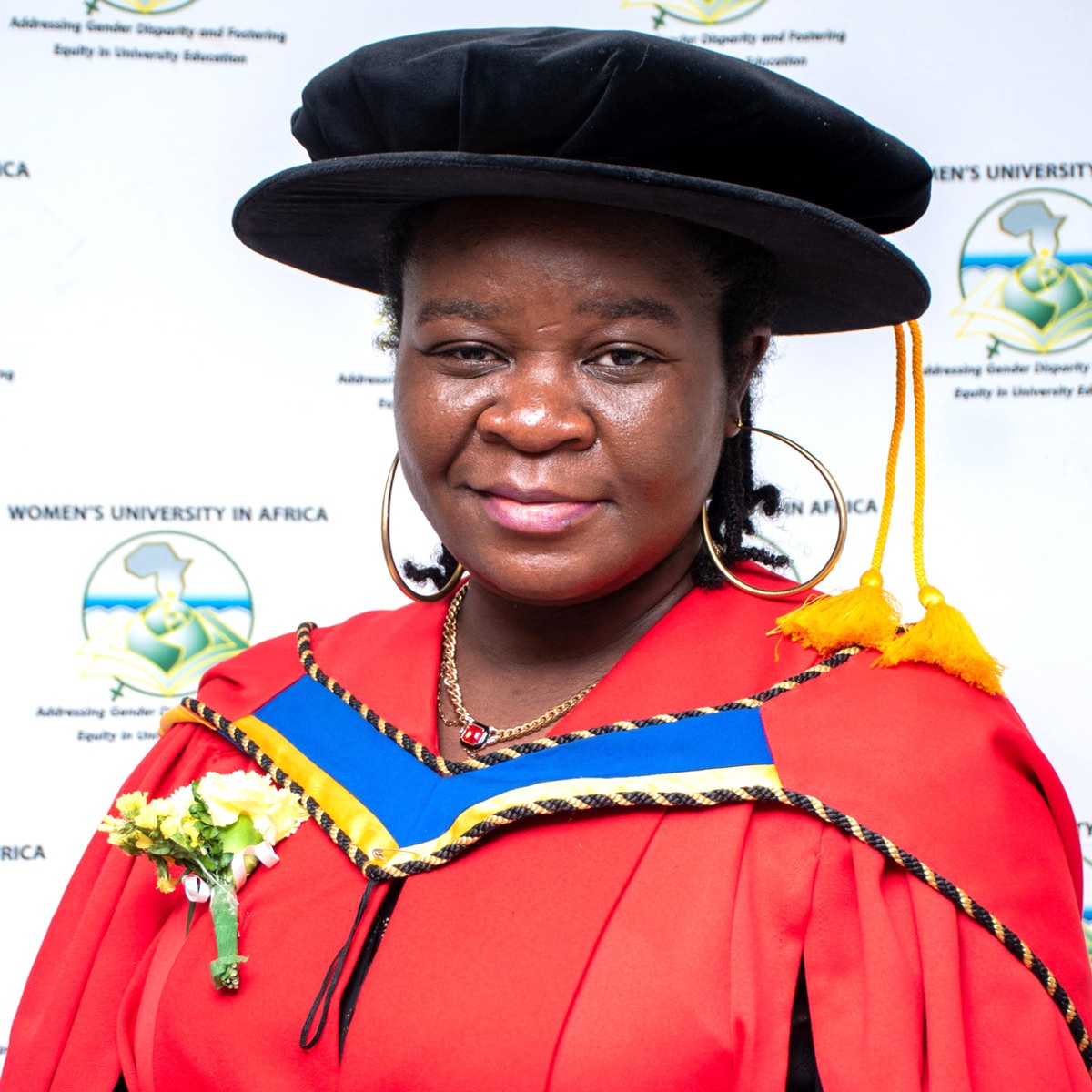
The Faculty of Social and Gender Transformative Sciences is the largest of all the Faculties in the University. The Faculty comprises four Departments: Continuing Education, Social Sciences, Family and Health Sciences and Gender and Transformative Sciences. With our competent, dynamic human resources, we offer a range of academic disciplines that are demand driven at the following levels: Certificates, Diplomas, Honours degrees, Postgraduate Diploma, Masters and PhD Programmes in different specialisations. The Faculty develops free-thinking, critical, creative, communicative and daring intellectuals, whose work is an important contribution to society, while their knowledge enriches the universal nature of humanity, simultaneously retaining various value systems and cultural identities. The mandate of the University is to promote gender equality in the provision of higher education in Zimbabwe and Africa at large. Our Faculty is at the heart of driving the University’s mandate as we house all the programmes and expertise on gender. We pride ourselves in producing gender
sensitive graduates who are game changers in society. Our research by staff and students is indeed transforming. The Faculty currently offers programmes through different flexible and innovative learning modes at our Harare and satellite campuses in Bulawayo, Mutare, Zambia and Malawi.As the Dean of the Faculty, I would like to welcome you all to our inspiring Faculty and urge you to navigate through
our programmes and join us in changing the world of Behavioural Sciences.
Preamble
Regulations for the Diploma in Education (Dip. Ed.) Specialising in Early Childhood Development (ECD) shall apply subject to provisions for both the University and Faculty General Academic Regulations. General Faculty Regulations shall normally take precedence over specific degree special regulations where both are read together.
Aims
The programme is designed to equip students with theoretical and practical knowledge,
skills, attitudes and values in handling ECD children from diverse contexts and with different
needs.
Objectives
By the end of the programme, students should be able to:
Admissions
Entry requirements:
A minimum of 5 O’ Level subjects, including English, Mathematics and a Science subject.
Duration of Programme
The Dip. Ed. specialising in ECD (Pre-Service) shall take three years full time to complete. It shall be offered on a semesterised basis.
Programme Structure
Assessment of the Students:
Each course shall be assessed based on course work and a final examination.
The weighting shall be as follows:
Coursework 30%
Examination 70%
Career Opportunities
Graduates of this programme would be able to work in the following different childcare settings:
Programme of Study
Dip. Ed. in ECD (Pre-Service) –Three Year Programme
Preamble
Regulations for the Bachelor of Education Degree in Early Childhood Development (ECD) shall apply subject to provisions for both the University and Faculty General Academic Regulations. General Faculty Regulations shall normally take precedence over specific degree special regulations where both are read together.
Aims
To equip students with theoretical and practical knowledge, skills, attitudes and values in handling ECD children from diverse contexts and needs.
Objectives
By the end of the programme, students should be able to:
Admissions
Entry requirements
Duration of Programme
The Bachelor of Education Degree in Early Childhood Development (Pre-Service) shall take four years full time to complete. It shall be offered on a semesterised basis.
Programme Structure
All B. Ed. in Early Childhood Developments (Pre-Service) students are expected to do a minimum total of twenty-eight courses. To meet these requirements, students undertake twenty-eight courses and a project on an approved ECD problem (a project is worth two courses).
Assessment of the Students:
Each course shall be assessed based on course work and a final examination.
The weighting shall be as follows:
Coursework 30%
Examination 70%
Career opportunities
Graduates of this programme will work in different childcare settings:
CAREER OPPORTUNITIES
Why Study Women’s and Gender Studies at Women’s University in Africa?
Duration: Three years
Entry requirements
5 ‘O’ Level subjects including English Language for those aged 40 years and above
At least 2 ‘A’ Level subjects
Opportunities for Women’s and Gender Studies Graduates
This specialist degree gives you a combination of critical thinking and problem-solving skills to prepare you for a career in:
Graduates of Women’s and Gender Studies will take up jobs as:
Programme Courses
| Course Code | First Year First Semester |
| WGS112 | Women and gender studies: An Interdisciplinary Introduction |
| WGS114 | Introduction to Feminist Theories |
| WGS115 | Introduction to Gender Relations |
| CS111 | Communication Skills |
| BCL111 | Basic Computer Literacy |
| First Year Second Semester | |
| WGS121 | Gender, Culture and Migration |
| WGS122 | Women and Work |
| WGS123 | Gender and Development |
| WGS124 | Modern African Women’s Voices in Film and Literature |
| WGS125 | Sociology and Gender |
| Second Year First Semester | |
| WGS211 | Psychology of Women and Gender |
| WGS212 | Women and Disaster Management |
| WGS213 | Feminist Ways of Knowing |
| WGS214 | Qualitative Research Methods |
| WGS215 | The Politics of Women’s Health |
| Second Year Second Semester | |
| WGS221 | Gender and Media |
| WGS222 | Women and Religion |
| WGS223 | Globalization and Trans-nationalism |
| WGS224 | Women as Agents of Change |
| WGS225 | Quantitative Research Methods |
| Third Year First Semester | |
| WGS311 | Gender, Sexuality and Society |
| WGS312 | Gender Community and International Organisations |
| WGS313 | Transformational Feminisms |
| WGS314 | Medicine, Religion and Politics in Africa and Diaspora |
| WGS315 | Social Justice and Law Reform |
| Third Year Second Semester | |
| WGS321 | Gender Mainstreaming in Organisations |
| WGS322 | Gender Globalization, Culture, Power and Trade |
| WGS323 | Women and Politics |
| WGS324 | Research Project |
| Code | Course | |
| PS 111 | Introduction to Psychology 1 | |
| SS111 | Sociology 1 | |
| SS112 | Cultural Anthropology 1 | |
| PS 112 | Introduction to Social Psychology 1 | |
| BCL 111 | Basic Computer Literacy | |
| CS 111 | Communication Skills |
| SS122 | Introduction to Gender Studies | |
| PS 125 | Introduction to Psychology 11 | |
| SW 121 | Sociology Institutions | |
| PS 124 | Social Psychology | |
| SS 121 | Cultural Anthropology 11 |
| SW 211 | Case Work | |
| SW 212 | Social Group Work | |
| SW 213 | Social Community Work | |
| SS 211 | Qualitative Research Methods | |
| SW 214 | Fundamentals of Social Work |
| SW 221 | Child Care and Protection Issues | |
| SW 222 | Issues in Integrated Social Work Methods | |
| SW 223 | Social Work and Health Issues | |
| SW 224 | Social Policy Issues | |
| PS 221 | Quantitative Research Methods |
| SW 311 | Fieldwork Practicum |
| SW 311 | Fieldwork Practicum |
| PS 225 | Counselling Psychology | |
| SW 411 | Social Work and Management | |
| BM 224 | Project Planning and Management | |
| SW 412 | Social Development Issues | |
| SW 415 | Research Project |
| SS 224 | Civil Society and Governance | |
| SW 421 | Social Work and Maladaptive Behaviour | |
| SW 422 | Social Work and Disability Issues | |
| SW 423 | Gender Mainstreaming in Social Work | |
| SW424 | Social Work and Disaster Management |
| Codes | Course | Credits |
| MDLS 111 | Disaster and Development Theories and Approaches | 16 |
| MDLS112 | Food and Livelihood Security in Disasters | 16 |
| MDLS 113 | Disaster Risk Assessment in Livelihoods | 16 |
| MDLS 114 | Livelihoods, Emergency Preparedness and Response | 16 |
| Codes | Course | Credits |
| MDLS 121 | Disaster Research Methods and Techniques | 16 |
| MDLS 122 | Monitoring and Evaluation of Disaster and Livelihoods Projects | 16 |
| MDLS 123 | Disaster Geo-Information and Livelihoods | 16 |
| MDLS 124 | Climate Change, Disaster and Livelihoods | 16 |
| MDLS 211 | Disaster and Livelihoods Research Project |
Regulation for Master of Science in Sociology and Gender Studies
Regulations for the Master of Science (MSc) in Sociology and Gender Studies shall apply subject to provisions for both the University and Faculty General Academic Regulations. Generally, Faculty Regulations shall normally take precedence over specific degree or diploma special regulations where both are read together.
This programme offers a wide range of courses based on contemporary issues in both Sociology and Gender, which have become very important means of interpreting contemporary social life in a critical manner. The theoretical orientations of this programme will include classical and contemporary Sociological theories as well as dominant Gender conceptual frameworks within the student’s programmatic emphasis.
There is a significant gap in the country on postgraduate programmes in this area which combines key contemporary sociological and gender issues. Data from analysis of Higher Education Institutions in Zimbabwe revealed that presently, institutions offer postgraduate degrees in either Sociology or Gender Studies. The Master of Science in Sociology and Gender Studies is therefore critical in that it takes an inter-disciplinary approach by combining the two fields of (a) Sociology and (b) Gender Studies. It also offers an opportunity for past and existing WUA students who pursued or are pursuing the Bachelors Degree in Sociology and Gender Development Studies to advance their studies in higher level studies (See attached the Needs Assessment Report).
To create a steady flow of national and international experts who are familiar with key theories and debates in Sociology and Gender Studies.
The overall objectives of the programme are to:
3.1 Provide participants with opportunities to acquire extended and specialised knowledge in Sociology and Gender studies in their theoretical as well as practical dimensions;
3.2 Map links between Sociology and other disciplines relevant to Gender studies.
3.3 Develop and enhance students’ familiarity with key theories and debates in Sociology and Gender Studies.
3.4 Foster an interdisciplinary approach to the study of Sociology and gender; and
3.4 Promote critical thinking on the application of contemporary sociological theories in addressing key normative questions of democracy and social justice from a gendered perspective.
Students completing the MSc in Sociology and Gender Studies will develop the following competencies:
6.0 Career Prospects and Employment Opportunities
The MSc in Sociology and Gender Studies is a programme that provides students with the knowledge, skills, and understanding to become better Practitioners in this field. Students studying for this programme will be able to work in many sectors, including in NGOs, government, and acclaimed academic and research institutions. They degree programme avails opportunities for graduates to be employed as researchers, development consultants, development workers, sociologists, among many other job opportunities.
Subject to provisions of the University and Faculty General Academic Regulations for admission, the following entry requirements shall apply:
This programme shall take one and a half years to complete on full-time basis delivered in block release and conventional classes. The entire Master’s degree shall consist of 8 core courses (offered in two batches of 4 courses each semester), and a dissertation.
9.0 Coursework Assessment
Students will be assessed using assignments (both group and individual) which may be presented in written or class presentation form. The Coursework Assessment will contribute 30% of the student’s overall mark while the examination makes up for the remaining 70%.
For admission to the examinations, a candidate must:
PROGRAMME STRUCTURE
STUDY TIME AND CREDIT HOURS PER COURSE
ACTIVITY STUDY TIME COMMITMENT (hours)
Contact time
Lectures 45
Seminars 20
Field visits 25
Sub-total 90
Self-Directed Learning
Preparation for scheduled sessions 15
Reading or practice 15
Writing assignments 15
Revision work 15
Sub-total 60
Scheduled assessment time
Final written examinations 3
In-class tests 2
Presentations 3
Practical skills 2
Sub-total 10
Grand total 120
Notional study time = 70 + 40+ 10
= 160 hours
1 credit = 10 hours
Therefore, credits for the Master of Arts Strategic Communication Programme (Level 9)
= 16 credits per course
| Code | Course | Notional Hours |
| MSG 111 | Politics and Social Theory | 16 |
| MSG 112 | Gender, Imperialism and International Development | 16 |
| MSG 113 | Sociology of Modernity | 16 |
| MSG 114 | Advanced Research methods | 16 |
First Year Semester One
First Year Semester Two
| Codes | Course | |
| MSG 121 | Gender Analysis and Development Practice | 16 |
| MSG 122 | Sociology of Law | 16 |
| MSG 123 | Contemporary Feminism | 16 |
| MSG 124 | Social Movements and Social Justice | 16 |
| MSG 125 | Dissertation | 32 |
Second Year Semester Three
Preamble
Regulations for the Master of Arts in Strategic Communication (MSCOM) (Level 9) shall apply subject to provisions for both the University and Faculty General Academic Regulations. Generally, Faculty Regulations shall normally take precedence over specific degree special regulations where both are read together.
Rationale for the Programme
Expert communication practitioners in various organizations are part of key personnel as their post cuts across the entire spectrum of activities and departments, and also link with critical external stakeholders, including the media. These practitioners' mange the human relations side of the business, which is as important as product quality or service delivery. As such, the job market has many positions that require communication experts. Yet there are only two universities in the country that offer communication related master's degrees, as opposed to the seven universities that offer communication related undergraduate programmes. Yet in Zimbabwe, there are only two universities which offer a postgraduate related qualification, despite having seven universities which offer communication related degrees. Introducing a Master of Art in Strategic Communication (Level 9) will enable graduates of this programme to be the best candidates for the job where such expertise is required. Additionally, the existent postgraduate programmes are geared more towards media studies, rather than communication. This programme will bridge this gap by offering a postgraduate programme that is centred on communication.
The environment in which most organisations operate necessitates the ability to adapt to the pace of change, technological advancement and economic instability. In such an increasingly technological, networked and everchanging society, this master's degree will empower its graduates with the advanced knowledge and expertise that is essential to achieve organisational goals, facilitate stakeholder relationships, reputation management, change management employee engagement and media relations at an individual, societal and global level. It would also produce graduates who possess emotional intelligence and strong negotiation skills. Therefore, these graduates would be expert communication practitioners and leaders.
Programme Aim
To offer students a unique blend of human and professional strategic communication theory and skills so that they are able to communicate appropriately and effectively in interpersonal, intercultural, organisational, and mediated settings.
Programme Objectives
The overall objectives of the programme are to:
1.4.1 Provide students with the knowledge and understanding of the theories of strategic communication and persuasion.
1.4.2 Equip students with advanced strategic communication knowledge and expertise that are essential to achieving organisational goals.
1.4.3 Equip students with emotional intelligence and strong negotiation skills.
1.4.4 Equip students with the ability to facilitate stakeholder relationships, reputation management, change management and media relations for an organisation; and
1.4.5 Produce graduates with the innovation and critical thinking skills required to be expert communication practitioners and leaders.
Learning Outcomes
By the end of the programme, student should be able to:
1.5 Admission
An admissions Committee administers the policy on admission to the MSCOM programme (Level 9) as per University Regulations, subject to approval by Senate.
1.5.1 Entry Requirements:
A good relevant first general degree (Level 7) or honours degree (Level 8) with an equivalent of 2.2-degree class or an advanced diploma from a recognised institution of higher learning, subject to approval by the Admissions Committee. Prior learning may also be considered by the Admission Committee. In the latter case, three references certifying the candidate’s ability and suitability to undertake the programme are required.
1.5.2 Exemptions:
There shall be no exemptions allowed for any course on the basis of courses previously taken at undergraduate, postgraduate or any other level in programme of study that is deemed to be equivalent to a prescribed course.
1.6 Duration of Programme
The MSCOM programme (Level 9) shall comprise eight taught courses and a dissertation.
The MSCOM degree (Level 9) shall be awarded to candidates who have successfully completed the approved courses and examinations at this University as set out below. There will be evening, holiday/block release and weekend classes which are taught over a total period of eighteen months years divided into three parts comprising two semesters that are devoted to taught courses; and the third semester that is devoted to the writing of a supervised dissertation.
1.7 Assessment of the Students:
Each course shall be assessed continuously and examined. Thus, normally evaluation shall be based on continuous assessment as well as examination.
The weighting shall be as follows:
Coursework 30%
Examination 70%
1.8 Career Opportunities
private sector and non-profit sector.
1.9 STUDY TIME AND CREDIT HOURS PER COURSE
ACTIVITY STUDY TIME COMMITMENT (hours)
Contact time.
Lectures 45
Seminars 20
Field visits 25
Sub-total 90
Self-Directed Learning
Preparation for scheduled sessions 15
Reading or practice 15
Writing assignments 15
Revision work 15
Sub-total 60
Scheduled assessment time
Final written examinations 3
In-class tests 2
Presentations 3
Practical skills 2
Sub-total 10
Grand total 120
Notional study time = 70 + 40+ 10
= 160 hours
1 credit = 10 hours
Therefore, credits for the Master of Arts Strategic Communication Programme (Level 9)
= 16 credits per course
1.10 Courses on Offer
All courses are compulsory.
First Year First Semester
Code Course Credits
MSC111 Theories and Principles of Strategic Communication 16
MSC112 Gender, Communication and Development 16
MSC113 Ethics and Strategic Communication 16
MDS113 Advanced Qualitative Research Methods 16
First Year Second Semester
Code Course Credits
MSC121 Advanced Strategic Communications 16
MSC122 Risk and Crisis Communication 16
MSC123 Public Diplomacy and Strategic Communication 16
MDS125 Advanced Quantitative Research Methods 16
Second Year First Semester
Code Course Credits
MSC211 Advanced Publication and Design 16
MSC212 Communication Training and Development 16
MSC213 Strategic Communications in a Digital Era 16
MSC214 Global Media and Cross-cultural Communication 16
Second Year Second Semester
Code Course Credit
MSC 221 Dissertation 32
Total Credits for the Programme are therefore 224 credits.